What Go Is and Why It Is Popular

A language built for simplicity and scale
Go (often called Golang) is an open-source, statically-typed, compiled language created at Google. It was designed to make building fast, reliable software simple: a small, easy-to-learn syntax, fast compilation, built-in concurrency, and a garbage collector. The philosophy is deliberately minimal – there is usually one obvious way to do a thing.
Compiles to a single binary
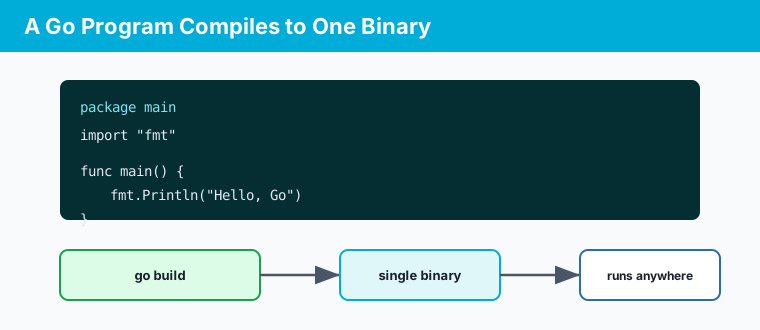
Go compiles your whole program – and its dependencies – into one self-contained native executable with no runtime to install. You copy that single file to a server and it runs. This is a big reason Go dominates cloud tooling.
Where Go shines
- Cloud infrastructure: Docker, Kubernetes, Terraform and Prometheus are all written in Go.
- Network services and APIs: fast, concurrent servers with a strong standard library.
- Command-line tools: a single static binary is trivial to distribute.
The trade-offs
Go keeps the language small on purpose. For years it lacked generics (added in Go 1.18) and it has no exceptions in the traditional sense – errors are values you check explicitly. Some find this verbose; others find it refreshingly clear. Either way, the result is code that is easy to read months later.
Key points
- Go is a compiled, statically-typed language focused on simplicity and speed.
- It builds to a single self-contained binary with no runtime to install.
- It powers major cloud tools and excels at network services and CLIs.
- The language is intentionally minimal – errors are explicit values.