
Type-3 JDBC-Net Pure-Java driver
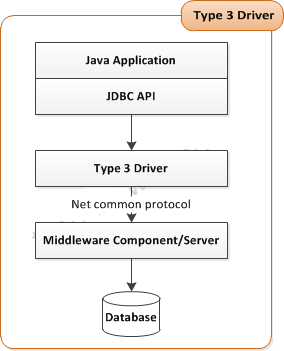
- Type 3 database requests are
passed through the network to the middle-tier server.
- The middle-tier then translates the request to the database.
Advantage :
- This driver is server-based, so there is no need for any vendor database library to be present on client machines.
- This driver is fully written in Java and hence Portable. It is suitable for the web.
- There are many opportunities to optimize portability, performance, and scalability.
- The net protocol can be designed to make the client JDBC driver very small and fast to load.
- The type 3 driver typically provides support for features such as caching (connections, query results, and so on), load balancing, and advanced system administration such as logging and auditing.
- This driver is very flexible allows access to multiple databases using one driver.
- They are the most efficient amongst all driver types.
Disadvantage :
- It requires another server application to install and maintain.
- Traversing the recordset may take longer, since the data comes through the backend server.
Type-4 Native Protocol Pure-Java driver
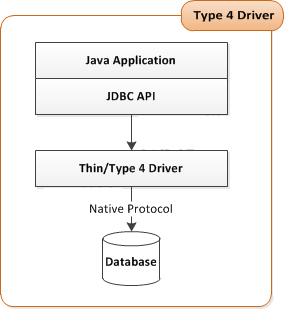
The Type 4 uses java networking
libraries to communicate directly with the database server.
Advantage
- The major benefit of using a type 4 jdbc drivers are that they are completely written in Java to achieve platform independence and eliminate deployment administration issues. It is most suitable for the web.
- Number of translation layers is very less i.e. type 4 JDBC drivers don't have to translate database requests to ODBC or a native connectivity interface or to pass the request on to another server, performance is typically quite good.
- You don't need to install special software on the client or server. Further, these drivers can be downloaded dynamically.
Disadvantage
- With type 4 drivers, the user needs a different driver for each database.